
Placing a first bulk order with a new supplier, there’s more than one place things can go wrong. The quote might not be as reasonable as it looks. The bulk order might not match the sample. The curl might not hold up under daily use. And when something does go wrong, the supplier might solve it quickly, or might stall for weeks. None of these concerns is huge on its own, but together they’re the reason a lot of buyers keep putting off that first large order.
This article walks through what’s worth checking before the money moves, in the order it usually comes up: sample testing, specifications and minimum order quantities, compliance paperwork, delivery, and how a supplier actually handles problems. Ten checks in total, covering what to look for in any wholesale eyelash extension supplier before your first order, so you can settle as much as possible up front.
Key Takeaways
- Order samples and test them the way you’d actually use them. Don’t judge from photos alone.
- How a supplier handles a problem tells you more than whether they’re a factory or a trading company.
- Pay close attention to whether curl is consistent across a full strip, whether the lashes release cleanly from the base, and whether fans open evenly.
- Minimum order quantity isn’t just about box count. Check how many strips are in each box too.
- Compliance documentation depends on where you’re selling. The US, EU, and UK each have different expectations.
Start With What You’re Actually Buying
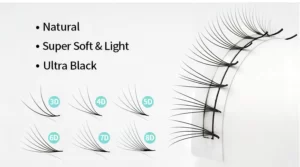
Before you compare suppliers, get specific about the product line you need. Klassieke wimpers, Russian volume, gemakkelijke ventilator, premade fan, and platte wimpers are different products to manufacture, and not every supplier is equally strong across all five. A supplier that’s excellent at premade fans isn’t automatically as strong on flat lashes.
| Product Type | Best suited for | What to ask about |
| Klassieke wimpers | Buyers wanting a natural, one-to-one look | Thickness range, curl consistency |
| Russische volume wimpers | Salons offering full, dramatic volume sets | Fan uniformity, base weight |
| Gemakkelijke waaierwimpers | Technicians who fan lashes by hand and want a faster workflow | How cleanly the lashes separate and open |
| Voorgemaakte wimpers | Salons prioritizing speed and consistency | Fan shape consistency, glue-ready base |
| Platte wimpers | Buyers wanting extra volume without extra weight | Flat-base adhesion, curl retention |
A useful early question is simply which of these products the supplier manufactures in-house. The answer usually tells you where their real strength is.
Look at How They Handle Problems, Not Just Whether They’re a Factory
Buyers often assume that going straight to a factory is automatically safer than working with a trading company or an integrated supplier. In practice, both models are common among wholesale eyelash extension suppliers, and both can work well. A factory controls production directly. An integrated supplier that works with several factories can put together a wider product range, sometimes stronger in different categories than any single factory could offer on its own, and act as a single point of contact for sourcing and communication.
What matters more than the label is how a supplier responds when something needs fixing. Before you commit to an order, it’s worth asking directly:
- What’s the process when a customer reports an issue with a batch?
- Can they speak to specific batches and how they’re traced back to production records?
- How detailed and specific are their answers? Do they explain a real process, or just offer a general reassurance?
A supplier that can walk you through an actual process, rather than just saying “quality is guaranteed,” is telling you something useful about how they’ll behave after you’ve paid.
Test Samples Properly
Photos on a supplier’s page or a marketplace listing tell you very little. The same images get reused across multiple sellers, and listings are copied often enough that a photo alone isn’t proof of anything. The only reliable way to judge a product is to get a physical sample and apply it the way you actually would in a real set.
| What to test | How to test it | What to watch for |
| Length and thickness accuracy | Measure against the stated spec | Mismatch from what was ordered |
| Curl consistency | Compare lashes across the full strip | Uneven curl within a single strip |
| Curl retention | Check curl after storing the sample properly for a period | Lashes going straight or losing shape |
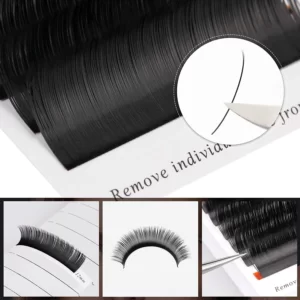
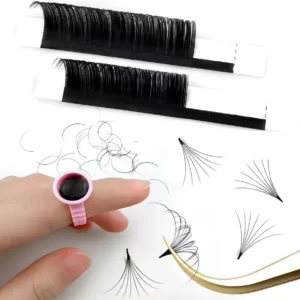
| Pickup and base adhesive | Pick up individual lashes with tweezers | Fibers sticking together, or a stringy residue between the lash and the base |
| Fan opening | Open a fan and check evenness | Lashes crossing or clumping instead of separating cleanly |
| Tip quality | Look at where each lash tapers | Blunt or uneven tips |
| Softness and weight | Handle the strip directly | Stiffness or noticeably heavy fibers |
| Color | Lay the deep matte, jet black, and semi-matte options side by side | Inconsistent tone across the same stated color |
| Backing card and tray | Check how the strip sits and lifts | Strips that shift or stick to the tray |
| Glue compatibility | Test with the adhesive you normally use | Poor bonding or unusually fast/slow set time |
The base adhesive strip matters more than it might seem. If it’s too tacky, lashes are hard to pick up cleanly. If it’s too loose, lashes can shed from the strip before you even use them, and picking up a fan sometimes leaves a few fibers behind that won’t lift off with the rest.
Ask About Quality Control and Batch Traceability
This follows directly from sample testing, because a good sample only tells you the sample is good. It doesn’t tell you whether the bulk order will match it. Ask what quality control looks like at each stage: incoming materials, during production, finished product, and a final check before shipping. It’s also worth asking whether the supplier keeps a retained sample from each batch, since that’s what makes it possible to trace a problem back to its source if one comes up later, and whether they can provide inspection records before your order ships.
Check the Full Range of Specifications
Once you know a supplier makes the product type you need and the sample checks out, confirm they can actually cover your full spec range: curl (J, B, C, CC, D, L, M, U, and similar), thickness, length, strips per box (commonly available in 6, 8, 12, 16, 18, and 20, and often customizable beyond that), and color options. If you use mixed-length trays, check whether the length distribution matches how you actually apply lashes in a set, not just a generic mix. If you’re a brand building a specific look, ask whether custom combinations of curl and length are available, and whether there’s a minimum for custom specs.
Minimum Order Quantity: Look at Boxes and Strips Together
Many suppliers’ typical practice is a minimum order around 100 boxes, with 12 strips per box as a common starting point. But box count alone doesn’t tell the full story. The number of strips in each box changes how much product, and how much money, a given order actually represents.
One practical way to reduce the size of a first order is to keep the box count the same but choose a lower strip count per box, such as 6 or 8. That gets you the same number of individual boxes to test with your own customers, at a lower upfront cost, and it works for mixed lengths and curls too if you want to test more than one specification at once.
Before comparing quotes, get the payment terms in writing as well. Suppliers vary in what they require, such as deposit percentage and whether the balance is due before or after shipping, and it’s worth confirming this alongside the price itself, not after you’ve already decided.
When you do compare quotes side by side, make sure you’re comparing the same thing: price per unit, packaging included or not, shipping method, and lead time. A lower headline price with a slower shipping method or no packaging included isn’t necessarily the better deal.
Understand Private Labeling and Packaging
If you’re building your own brand, ask what packaging options are available. Plastic trays, magnetic boxes, and other formats vary by supplier, and so does who handles the backing card design and print. Design work is often provided free, while the cost of producing a proof and running the packaging in bulk is usually itemized separately in the quote.
Before your packaging goes into full production, confirm that the proof, meaning logo placement, backing card text, and any included instructions, matches the final specification exactly. Catching a mismatch at the proofing stage is straightforward. Catching it after a full production run isn’t.
It’s also worth confirming the packaging minimum order quantity separately from the lash minimum order quantity, since the two aren’t always the same number.
Confirm Lead Time, Shipping, and After-Sales Support
Commonly used lengths and curls are often kept in stock, which is useful if you want to test a specification quickly rather than waiting on a custom production run. Custom specs typically need their own lead time, so confirm that separately before you plan around it.
For shipping, faster methods generally cost more and slower methods cost less. The right choice depends on how urgently you need the order. Ask how the supplier packs shipments: strips packed neatly, with cushioning inside the box to prevent movement in transit, is a reasonable baseline to expect.
Before you order, get clear, specific answers on returns and exchanges: what counts as a qualifying issue, what proof you’ll need to provide (photos or video are typical), and whether the remedy on offer is a reshipment, a partial refund, or a discount on a future order. A supplier that can answer this clearly and specifically before you’ve paid anything is usually easier to work with if something does go wrong later.
Ask, too, what happens after the sale. Whether a sample from your batch is retained on their end, and what their process looks like if you report an issue: do they investigate with the production team, or just offer a blanket apology and move on.
Check the Compliance Paperwork for Your Market
Requirements differ depending on where you’re selling.
| Market | What to know | What to ask your supplier for |
| United States | Cosmetic and eyelash adhesive products fall under FDA cosmetic regulations; individual states may have additional requirements | Relevant safety documentation and ingredient information for the products you’re importing |
| European Union | Lash adhesives and related products generally need to meet REACH chemical safety eisen | REACH compliance documentation |
| United Kingdom | Similar cosmetic safety framework to the EU, with UK-specific registration in some cases | UK-applicable compliance documentation |
This isn’t legal advice, and requirements change. Check current rules for your specific market and product category before you finalize an order.
Run a Final Communication Test
Before placing the order, send the same three questions to every supplier you’re considering. Ask something specific from the checks above, like their batch traceability process, their return policy, or their packaging minimum, and compare how quickly they respond and how specific the answers are. This isn’t a separate step so much as a final check on everything above: it tells you whether what a supplier says on their page holds up once you ask a direct question.
Supplier Scorecard
Use this to compare suppliers side by side on the same criteria.
| Criteria | Supplier A | Supplier B | Supplier C |
| Product range matches your needs | |||
| Sample quality (curl, pickup, fan opening) | |||
| Batch traceability / QC process | |||
| Specification range (curl, thickness, length, strips/box) | |||
| MOQ flexibility | |||
| Private label / packaging options | |||
| Lead time for common specs | |||
| Shipping options | |||
| Return/exchange terms | |||
| Compliance documentation available | |||
| Response time and specificity |
How Alice Eyelash Handles This
- Full specification range covering the curls, thicknesses, and lengths listed above, in 6, 8, 12, 16, 18, and 20 strips per box, plus three color options.
- Free samples (buyer covers shipping), so you can run the tests above before committing to a bulk order.
- Free design support for logos, labels, backing cards, and boxes.
- A minimum order that starts around 50 boxes, lower than the roughly 100-box norm common elsewhere in the industry, with the option to choose fewer strips per box to reduce first-order investment further.
- Commonly used specifications kept in stock for faster testing.
- A retained sample from every batch, to support traceability if a question comes up later.
- Packing and after-sales support alongside the quality control process described above.
FAQ
What’s a typical minimum order quantity for a wholesale eyelash extension supplier? It varies by supplier, but many suppliers’ common starting point is around 100 boxes at 12 strips per box. Some suppliers, including Alice Eyelash, offer lower minimums and the option to reduce strips per box, which lowers the size of a first order.
Should I order samples before placing a bulk order? Yes. A sample lets you test curl consistency, pickup, fan opening, and color in person, which photos alone can’t show you. It’s the most reliable way to confirm a listing matches what actually arrives.
Does it matter if a supplier is a factory or a trading company? Both models are common, and both can work well. What matters more is how specifically they can explain their quality control process and how they handle a problem after you’ve placed an order.
How long does curl retention typically last? This depends on the product and how it’s stored. Under reasonable storage conditions, a well-made lash should hold its curl through normal handling. Ask your supplier directly about curl retention under your specific storage setup.
Can I sell wholesale eyelash extensions under my own brand? Many suppliers, including Alice Eyelash, offer private label options: custom packaging, backing cards, and logo placement. Confirm the packaging minimum order quantity separately from the lash minimum, since they’re often different numbers.
Ready to run these checks yourself? Neem contact met ons op with the styles and quantities you’re considering, and we’ll follow up with samples and a quote.


 EN
EN  DE
DE  ES
ES  FR
FR  IT
IT  JA
JA  KO
KO  DA
DA  NL
NL  FI
FI  PL
PL  SV
SV  PT
PT  ZH
ZH